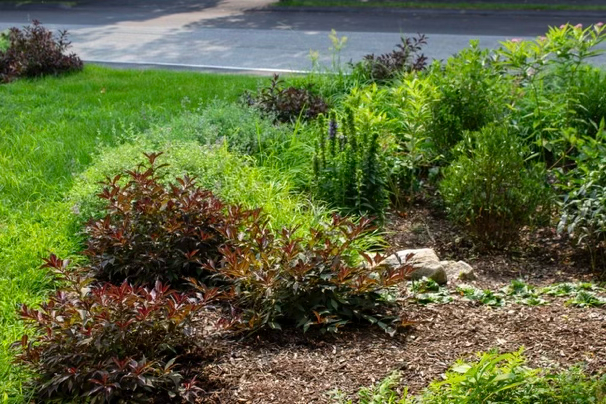
Native plantings edge a Wellesley rain garden.
There’s a spot in many MetroWest yards that everyone recognizes but few people love. It’s the low corner that holds water for days after a hard rain. It might sit beneath a downspout where nothing will grow, or along a driveway where water runs off and disappears into a storm drain.
We tend to think of water draining as a solution. If the water is gone, the problem is over.
But that sense of resolution is misleading. The water has simply moved elsewhere, carrying oil, fertilizer, pet waste, and pesticide residue with it. All of this flows into nearby storm drains untreated and from there into streams, rivers, and ponds. In towns with older combined sewer systems, heavy rain can make matters worse. When the pipes are overloaded, these systems are designed to release sewage-laden water directly into local waterways. Unfortunately, heavy rainstorms that trigger these overflows are becoming more frequent.
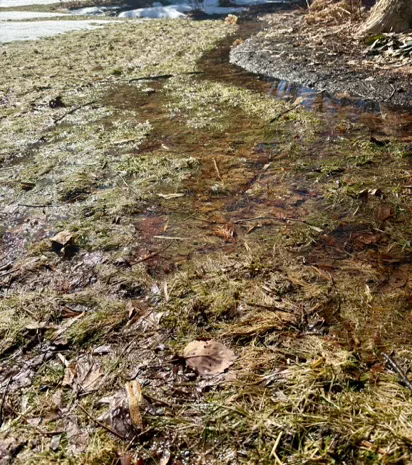
A single rain garden won’t fix our regional infrastructure, but it can change what happens on your property. One yard becomes a visible example, creating a ripple effect in our neighborhoods and encouraging others to rethink how they manage water.
What is a Rain Garden?
A rain garden is a shallow, planted depression designed to collect runoff before it exits your property. Instead of traveling across impervious surfaces and into the street, water is directed into your garden, where it can be absorbed by deep-rooted native plants or filtered slowly into the soil. The depression isn’t meant to hold water indefinitely; most rain gardens completely drain within 24 to 48 hours.
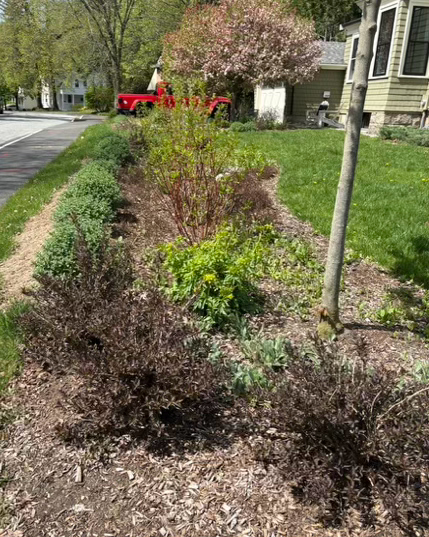
Because of this, there is no standing water where mosquitoes can breed. A rain garden is not a pond or a bog—it’s an intentional, well-designed pollinator garden first and a filtration system second.
Rain gardens are living habitats in the ecological landscape. Because some of the most spectacular New England native plants thrive in these conditions, they can be as beautiful, or even more so, than any other planting bed on your property. The water management happens below the soil; above, a layered system of native plants provides nectar, host plants, and shelter for insects, birds, and pollinators throughout the season.
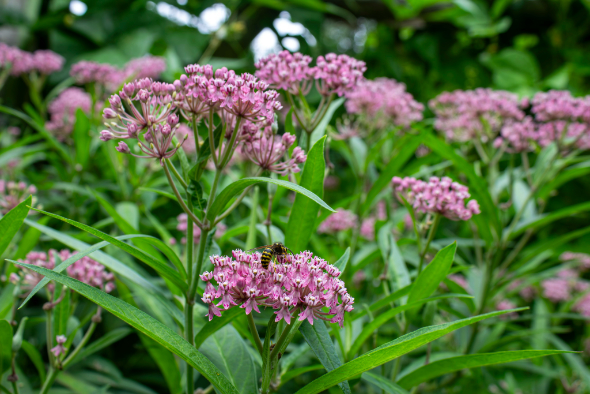
In the wetter areas at the bottom of the depression, you might find Joe Pye Weed (Eutrochium), Swamp Milkweed (Asclepias incarnata), and Cardinal Flower (Lobelia cardinalis). Along the drier rim, Little Bluestem (Schizachyrium scoparium) and New England Aster (Symphyotrichum novae-angliae) flourish. These “pollinator powerhouse” plants bloom over an extended period and provide winter structure, making the garden both ecologically productive and visually striking.
From Runoff to Environmental Resource
In MetroWest, you can still find wooded areas, streams, and ponds where a great blue heron might appear at dusk. But there are also many houses, driveways, patios, and compacted lawns that cannot absorb water when it rains. With nowhere else to go, the water runs across these surfaces
and collects in the lowest spots, carrying with it whatever is on the ground.
Climate models show that as temperatures rise, the Northeast is likely to see more intense rain events. Total precipitation may not increase, but it will fall in shorter, harder bursts. Low areas in MetroWest yards that once flooded once or twice a year could flood four or more times. Summers will remain dry, followed by sudden heavy rains that can overwhelm lawns and landscapes never designed to handle that much water.
Cities and towns are responding with what’s called green stormwater infrastructure. This includes rain gardens, restored wetlands, permeable pavement, and street trees, designed to reduce the amount of water running into storm drains.
The same approach works at the residential level: a rain garden in Natick or Wellesley can function like a municipal bioretention cell, but on a smaller, single property scale. When residents combine efforts, the benefits add up.
What a Rain Garden Gives Back
A rain garden installed where water naturally collects—at a downspout, the base of a slope, or a low spot—can dramatically reduce runoff. Native plants with deep root systems absorb water like a sponge, turning a persistent problem into a solution.
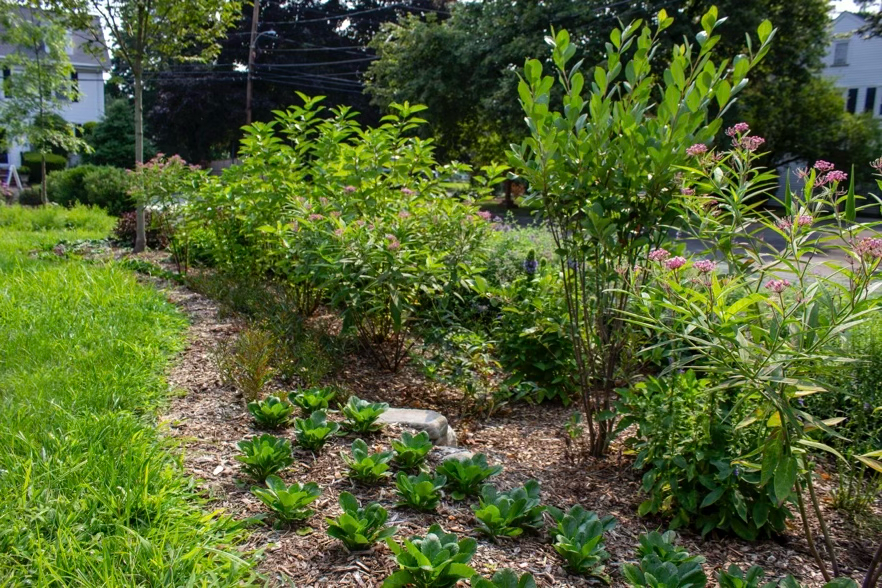
A rain garden doesn’t ask for much once it’s established. It just wants to be left alone to do its job. All you need to do is enjoy it and watch how it changes through the seasons. In spring you will see its crisp green foliage unfurling. In the summer, it matures into a garden full of colorful blooms. By fall, its leaves change to reds, yellows, and oranges, and soon you see seed-heads and dried stems that hold the light in a way that makes even a gray day bright.
The Sweetgum Approach
A rain garden may not be right for every yard, but it’s worth exploring. Placement and soil conditions matter: gardens should be located away from foundations and septic systems, in areas where water can soak in rather than sit. Poor drainage, heavy clay, or high groundwater can limit effectiveness, and properties near wetlands may require local review.
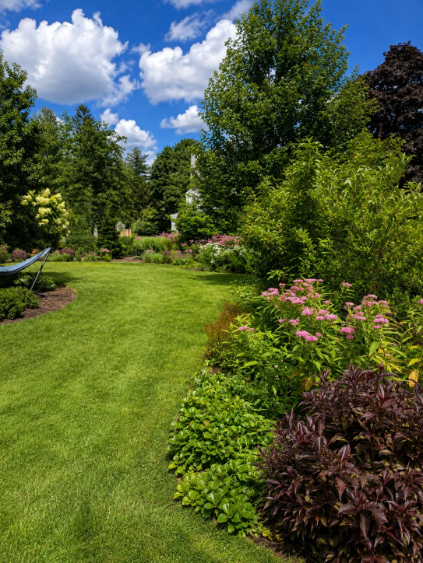
That’s why we start by looking at the whole property. Where are the low spots, and how is water moving—off roofs, across lawns, or from neighboring yards? Understanding that flow allows us to address the source, not just the symptoms.
From there, we design for your specific site. Plant selections are tailored to your light, soil, and moisture conditions, using native species that will thrive, support wildlife, and look beautiful for years to come.
In the Stormwater Solutions Package, we offer opportunities to enhance your outdoor living spaces with features such as rain gardens, bioswales, and permeable pavers, while protecting your home and neighborhood.
Text by Christine George. Photos by Allison Conwell and Christine George. Copyright Sweetgum Horticulture 2026